
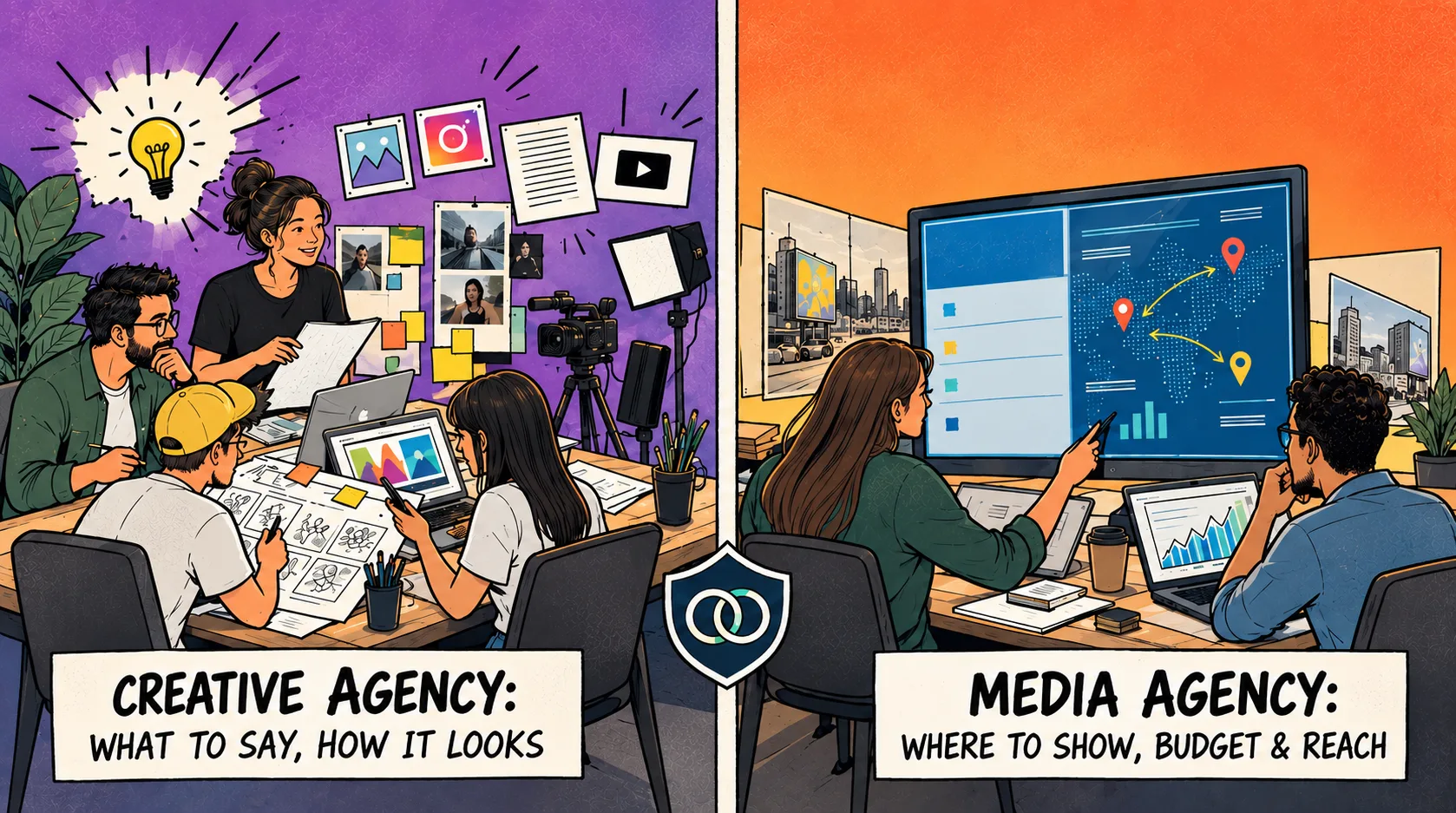
A creative agency decides what your brand says and how it looks and sounds, from the campaign idea to the videos, social content, design and copy that bring it to life. A media agency decides where and when that work is seen, and how the budget is spent across channels to reach the right people at the right cost. Most brands need both skills at some point, and the best results come when the two are planned together rather than handed from one team to the other.
What does a creative agency do?
A creative agency is responsible for the message and the work itself. It starts by understanding the brand, the audience and the problem the business needs to solve, then turns that understanding into an idea worth communicating. From there, the team brings the idea to life through the content people actually see and hear, which might include brand and campaign videos, social media content, design, photography, copywriting and the look and feel that ties it all together.
The value of a good creative agency lies in making a brand noticed, understood and remembered. Its success is judged by whether the work stands out in a crowded feed, whether it communicates the right message clearly, and whether it moves people to think, feel or act differently about the brand. A content creative agency like LOKi places particular focus on the ongoing content that keeps a brand present between big campaigns, not only on the headline launch.
What does a media agency do?
A media agency is responsible for getting the work in front of the right people as efficiently as possible. It studies where the target audience spends its time, recommends which channels to use and how to divide the budget between them, and then plans, buys and manages the media placements, whether that's social and search advertising, digital display, out of home, television or radio. Once a campaign is live, the media team monitors performance, adjusts targeting and spend, and reports on the results.
A media agency's success is judged by reach and efficiency, meaning how many of the right people saw the campaign, how often, and at what cost for each result. Larger media agencies can also bring buying power and negotiated rates across many channels, which matters for brands with significant budgets.
Here's how the two compare side by side.
Creative agency | Media agency | |
|---|---|---|
Core question | What should we say, and how should it look and sound? | Where and when should it be seen, and by whom? |
Main work | Strategy, campaign ideas, video, social content, design and copy | Channel strategy, media planning, buying, targeting and optimisation |
Main output | The content and creative assets | The media plan and the placements that run them |
Judged by | Whether the work is noticed, understood and remembered | Reach, frequency and cost efficiency |
Best for | Brands that need a clear message and strong content | Brands that need to spend a media budget well across channels |
Why the line between them has blurred
Not so long ago, the division was fairly clean. The creative agency made a television commercial and a set of print ads, and the media agency bought the airtime and the pages to run them. Digital and social media have made that separation much less tidy.
On today's platforms, the creative itself has a large influence on how well the media performs. The same budget can deliver very different results depending on how strong the opening seconds of a video are, whether the format suits the platform and how closely the message matches the audience being targeted. At the same time, media teams now produce a constant stream of data about what people respond to, which is exactly the insight a creative team needs to make the next piece of content better.
As a result, you'll find agencies that call themselves digital, integrated or full-service and offer a mix of both. Some are genuinely strong across creative and media, while others lead with one and offer a lighter version of the other. That isn't necessarily a problem, but it's worth understanding where an agency's real strength lies before you appoint it, so you know which part of the job you're really buying. If you're also weighing up whether you need a performance-focused team or one that builds the brand as well, we've unpacked that in more detail in Digital Marketing Agency vs Digital Creative Agency: What's the Difference and Which Does Your Brand Need?
Which one does your brand need?
The honest answer depends on where the gap is in your marketing today. If your brand already has strong, distinctive content and a clear message, but it isn't reaching enough of the right people, a media partner is likely to make the biggest difference. If you have the budget and the channels in place, but the content feels generic, inconsistent or tired, then a creative partner is where your next investment will have the most impact.
For many brands in Singapore, especially those running regular campaigns across several platforms, the answer is both, working closely together. A useful way to decide is to ask yourself a few simple questions. Are people seeing our content but not responding to it? That usually points to a creative challenge. Are people responding well when they see it, but too few are seeing it? That usually points to a media challenge. And if you can't yet tell which is the case, it's often a sign that the two sides aren't sharing enough information with each other.
Making creative and media work together
When a brand works with separate creative and media partners, the most common problem is that the two only meet at the handover. The creative team finishes the work and passes it along, and the media team then discovers that the formats don't suit the placements, or that the message was never designed for the audiences being targeted.
A few simple habits avoid most of this. Brief both partners together, or at least share the same brief with both, so they're working towards one objective. Agree the channels and formats early, so the creative can be made for the places it will actually appear, including the vertical, silent and short versions that social platforms favour. Once the campaign is live, share the performance data with the creative team as well as the media team, so that what's learned about the audience feeds straight into the next round of content. As we explored in Should Your Organic and Paid Content Be the Same?, the best results come when every piece of content is planned with its channel and its job in mind from the very start.
So which partner do you need, and why LOKi?
The honest answer is that it depends on where the gap in your marketing sits today, and that can change from one campaign to the next. That's exactly why we've built LOKi to be flexible. On some campaigns we play the creative role, developing the idea and producing the content while working alongside a client's existing media partner. On others we step into the media role, planning and managing the channels for content the brand already has. And for many of our clients, we take on the whole journey end to end, from strategy and creative through to production, media and the optimisation that follows once the campaign is live.
Whichever role we play, we bring the same belief to it, which is that creative and media perform best when they're planned together from the very first brief. Because our team works on both sides, the creative we make is built for the channels it will run on, and the media we manage is shaped by an understanding of what makes content connect. It also means you don't need to decide on day one exactly what kind of agency you're looking for. Tell us what you're trying to achieve and where you feel the gap is, and we'll recommend the role that will make the biggest difference, whether that's one part of the job or all of it.
If you're weighing up your next campaign, get in touch with us and we'd be glad to talk it through with you. You can also find out more about LOKi and see some of our work before we chat.
Frequently asked questions
What is the difference between a media agency and a creative agency?
A creative agency decides what your brand says and how it looks and sounds, developing the idea and producing the videos, social content, design and copy that bring it to life. A media agency decides where and when that work is seen, planning and buying the channels and managing the budget to reach the right people at the right cost. The real difference lies in which half of the problem each one is built to solve, and whether anyone is connecting the two.
Do I need a media agency if I already have a creative agency, or the other way round?
It depends on where the gap sits. If your creative partner produces strong work but it isn't reaching enough of the right people, media expertise will make the bigger difference. If your media is well managed but the content feels generic or tired, a stronger creative partner is where your next investment should go.
Can one agency handle both creative and media?
Yes, and for many brands it's the more effective setup, because the creative is made for the channels it will run on and the media is guided by an understanding of what makes the content work. The key is to check that the agency is genuinely strong on both sides, rather than leading with one and offering a lighter version of the other.
Is it more cost-effective to use one agency for creative and media?
Often, yes. Working with a single agency reduces the time spent coordinating between separate partners, avoids duplicated strategy and reporting, and cuts down on the rework that happens when creative arrives in formats that don't suit the media plan. The more useful question is not what each partner costs, but how much of the combined budget is actually working for your brand.
How do I know whether my problem is creative or media?
A few signals are worth watching. If people are seeing your content but not engaging, clicking or remembering the brand, the issue is usually creative. If people respond well when they see it but too few are seeing it, the issue is usually media. If your results are flat and you can't tell which is the cause, it's often a sign that your creative and media teams aren't sharing enough information with each other.
Who should I brief first, the creative agency or the media agency?
Ideally both at the same time, using the same brief and the same objective. Briefing them together means the creative is made for the channels it will run on, and the media plan is built around content designed to perform there.
Is a digital marketing agency the same as a media agency, and how is it different from a digital creative agency?
They overlap but aren't the same. A digital marketing agency is focused on performance, driving traffic, leads and conversions through channels such as SEO, paid ads and email, which puts it closer to the media side of the work. A digital creative agency can run those same channels, but also brings brand strategy, creative concepting and production, so the brand and the performance are built from the same foundation. We explain the difference in more detail, including a guide to which one suits your situation, in Digital Marketing Agency vs Digital Creative Agency: What's the Difference and Which Does Your Brand Need?
Does LOKi work as a creative agency, a media agency or both?
All three, depending on what your brand needs. LOKi is an independent digital creative agency working with brands in Singapore, and on some campaigns we play the creative role alongside a client's media partner, on others we take on the media role, and for many clients we run the whole journey end to end. You can explore our work here or find out more about us, and if you're still working out which kind of partner you need, we're happy to have that conversation before you commit to anything.